
The AI-Ready Commercial Office: A Guide for Industrial Manufacturers and Distributors
Most industrial companies already use AI somewhere. It drafts emails, summarizes meetings and shows up as a new button inside the CRM.
What it rarely does yet is change how a quote gets priced, how an order gets entered, or how a forecast gets built.
That gap is not a technology problem. It is a foundation problem.
In brief
AI scales whatever process it lands on. On a manual process with fragmented data, it adds activity without improving results.
The commercial office needs five foundations before AI pays back: customer master, price and quote data, pipeline and activity, process ownership, and a system of record.
Start with one lead-to-cash step. Measure it, fix its data and rules, then add AI and compare against the baseline.
In this guide
What the data says
Why the commercial office is harder than the plant
The five foundations
Where you stand: a maturity model
Where AI pays off first
How to sequence the work
Before you buy an AI add-on
How ownership changes the timing
A quick self-assessment
This guide is for industrial manufacturers and distributors of any ownership: private equity backed, family or founder owned, or a subsidiary of a larger group. The foundations are the same in each case. Section 8 covers what changes.
1. What the data says
The research below is current as of October 2026. Several sources sell software in this space, which is noted. The pattern across them is consistent.
Fewer than 40% of sellers will say AI agents improved their productivity by 2028, Gartner predicts. Sales leaders who overhaul data, automation and user experience will be five times more likely to see a return. In Gartner's words, agents "are only as effective as the systems they operate within." (Gartner survey of 210 chief sales officers, July 2026)
51% of manufacturers whose AI pilots fell short cited data quality as a reason, ahead of integration challenges at 43%. (RSM Middle Market AI Survey, 129 manufacturers, July 2026)
73% of distributors expect pricing AI to improve margin by 2% or more. 16% have achieved it so far. (NAW and MDM, 426 distribution leaders, April 2026; reported by a columnist who sells pricing software)
34% of distributors using a CRM log at least three quarters of customer interactions in it. 22% do not track forecast accuracy at all. (Phocas Software, State of Sales in Distribution 2026; Phocas sells analytics software)
No surveyed Salesforce partner named Salesforce's AI agent product as a primary driver of new bookings. Analysts pointed to enterprise data still too fragmented for practical AI use. (TD Cowen partner survey, reported August 2026)
None of this says AI does not work in the commercial office. It says the return depends on the foundation underneath it, and most commercial offices have not built that foundation yet.
2. Why the commercial office is harder than the plant
On the plant floor, AI arrived on top of decades of instrumented data: machine sensors, quality records, maintenance logs and standard work. Plant data is generated by machines on a schedule.
Commercial data is generated by people, inconsistently, across several systems. Five conditions make it harder to prepare:
The same customer exists several times. Once in the ERP for billing, again in the CRM under a slightly different name, and again in each acquired company's system. Any AI that prioritizes or forecasts by customer works from a split picture.
Prices live in exceptions. Real prices are contract terms, discounts approved by email and legacy deals that never expired. AI that learns from pricing history will learn the exceptions as if they were policy.
Activity is not recorded. Sales conversations happen in person, by phone and by text. If most never reach the CRM, any model predicting which deals close is working from a small, biased sample.
Rules live in people's heads. Account ownership, discount authority, lead routing and quote expiry are often known rather than written. AI cannot follow a rule nobody has written.
No single system is the system of record. The ERP, CRM, quoting tool and spreadsheets each hold part of the truth, and they disagree. Until someone decides which system wins for each field, AI will surface the disagreement rather than resolve it.
3. The five foundations
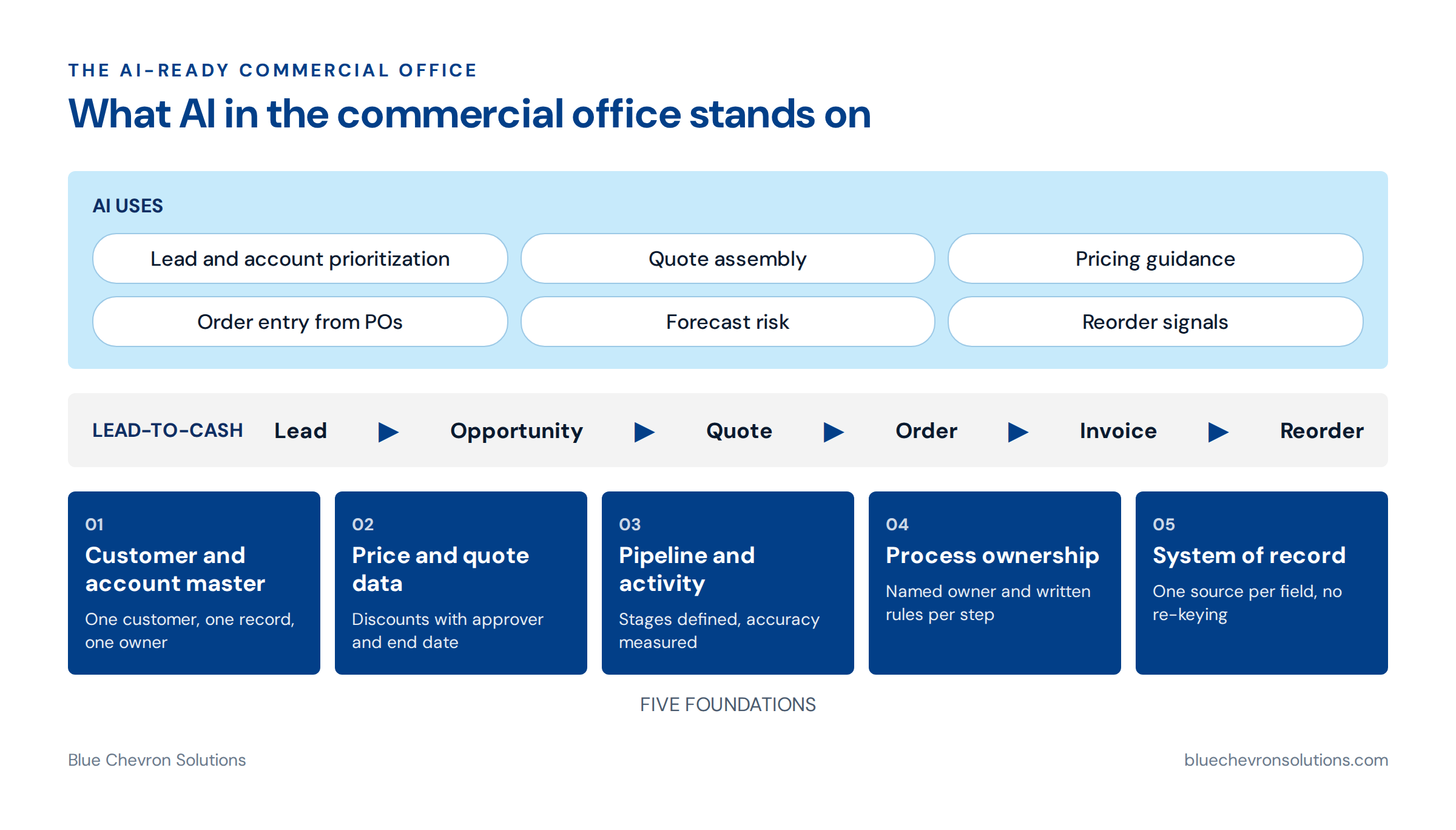
Each foundation below has three parts: what good looks like, why AI depends on it, and one question to test where you stand.
Foundation 1: Customer and account master
What good looks like: One customer, one record, linked across ERP and CRM, with a clear parent and child hierarchy and a named owner. Acquired customer bases are matched into the existing model, not added alongside it.
Why AI needs it: Every commercial AI use, from account prioritization to churn signals to territory planning, is organized by customer.
Test it: For your top 50 customers, can you produce total revenue, open pipeline and the account owner from one place in under an hour?
Foundation 2: Price and quote data
What good looks like: Price files, contract pricing and discount history live in a system, not in documents and inboxes. Every discount has an approver, a reason and an end date. Quotes are saved with their outcome and the reason.
Why AI needs it: Pricing guidance, quote assembly and margin analysis all learn from history. Incomplete history produces guidance that repeats the same leakage, faster.
Test it: Can you list every customer paying below standard price today, who approved it, and when it ends?
Foundation 3: Pipeline and activity
What good looks like: Opportunity stages have written exit criteria. Customer interactions are logged consistently. Forecast accuracy is measured every period against what actually closed.
Why AI needs it: Forecasting and deal-risk tools need a baseline. Without today's accuracy, there is no way to know whether AI improved it.
Test it: What was your forecast accuracy last quarter, and who measured it?
Foundation 4: Process ownership
What good looks like: Every step from lead to cash has a named owner and written rules: lead routing, account assignment, discount authority, quote approval, order entry checks and reorder follow-up.
Why AI needs it: An AI tool can apply a rule thousands of times a day. Someone has to own the rule, decide when it changes and review what the tool does with it.
Test it: If a discount request above the normal limit comes in today, would three people in the company describe the same approval path?
Foundation 5: System of record and integration
What good looks like: For each important field (customer name, price, account owner, order status), one system is the source and the others read from it. The ERP, CRM and quoting tools pass data automatically.
Why AI needs it: AI built into one application only sees that application. If orders are re-keyed from the CRM into the ERP, the AI in either system works from a copy that may already be wrong.
Test it: How many times is a typical order typed by a person between the quote and the invoice?
4. Where you stand: a maturity model
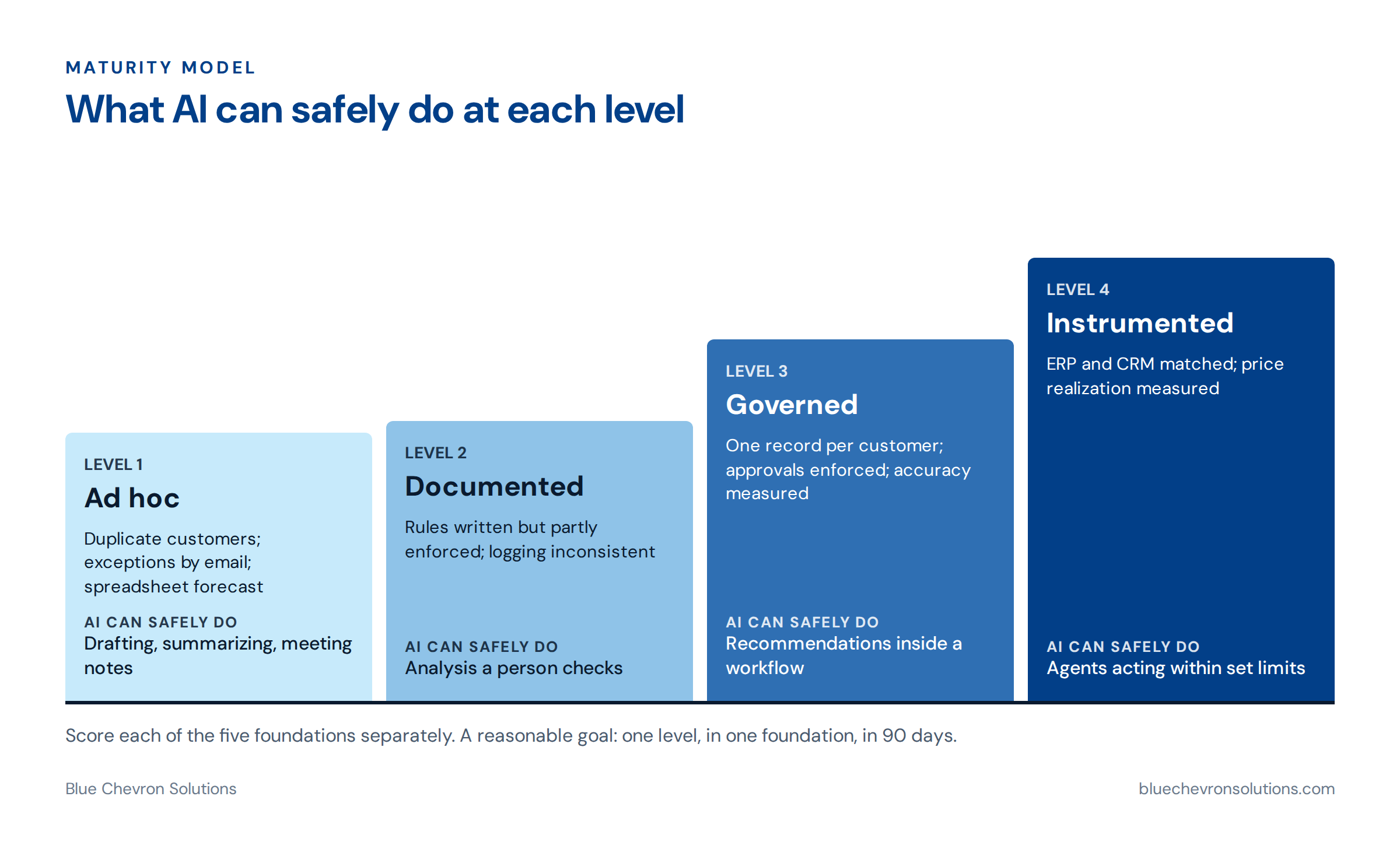
Most industrial companies sit at Level 1 or 2 in at least one foundation. That is normal. The value of the model is that it shows what AI can safely do at each level, which keeps you from buying tools the foundation cannot support.
Level 1, Ad hoc. Duplicate customers, pricing exceptions handled by email, forecast built in a spreadsheet. AI can safely do: personal productivity, such as drafting, summarizing and meeting notes.
Level 2, Documented. Hierarchy and discount policy written down but only partly enforced; stage criteria exist but logging is inconsistent. AI can safely do: analysis a person checks, such as account research, data cleanup suggestions and quote document assembly.
Level 3, Governed. One record per customer, approvals and end dates enforced in the system, forecast accuracy measured each period. AI can safely do: recommendations inside a workflow, such as lead prioritization, pricing guidance with human approval, and order entry from purchase orders with review.
Level 4, Instrumented. ERP and CRM matched automatically, price realization measured by customer and product, leading indicators tracked weekly. AI can safely do: agents that act within set limits, such as routine quotes, reorder prompts and forecast risk alerts, with exceptions routed to people.
Moving one level in one foundation is a reasonable 90-day goal. Trying to move every foundation at once is the most common reason the effort stalls.
5. Where AI pays off first
The best first uses share three traits: the step repeats often, its cost can be measured today, and a person still makes the final call on price and exceptions.
Lead and account intake. First use: score and route inbound leads; prioritize accounts. Ready when every lead gets an owner within a set time today.
Quoting. First use: assemble quotes from past quotes; flag margin below policy. Ready when most quotes are saved with their outcome.
Pricing. First use: suggest a price range; flag discounts outside policy. Ready when below-standard pricing can be listed by customer.
Order entry. First use: read purchase orders and emails into draft orders for review. Ready when order errors are measured today.
Pipeline and forecast. First use: flag at-risk deals; compare forecast to historical conversion. Ready when forecast accuracy is tracked each period.
Reorder and retention. First use: flag customers whose ordering pattern changed. Ready when customer retention is measured.
Price increases. First use: check that announced increases reached every invoice. Ready when contracted price can be compared to billed price.
Where to wait. Two uses deserve caution until a foundation reaches Level 3. Letting AI set or negotiate price on its own, because it will repeat the exceptions in your history. And replacing the forecast with a model before you know the current forecast's accuracy, because there is no baseline to compare against.
6. How to sequence the work
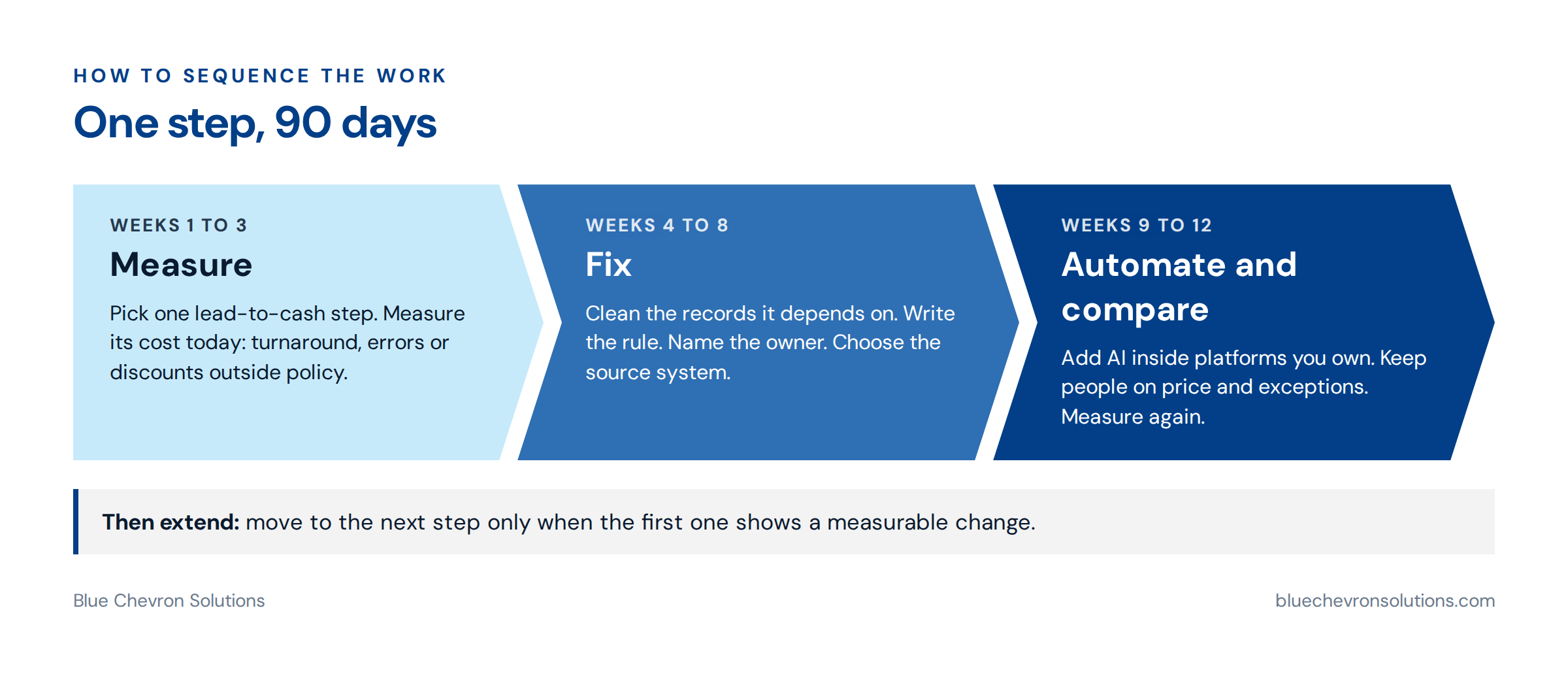
Companies that get a return from AI in the commercial office tend to follow the same order.
Weeks 1 to 3: Choose one step and measure it. Pick the lead-to-cash step where manual work costs the most and is easiest to measure: quote turnaround, order entry errors, or discounts outside policy. Measure it as it stands.
Weeks 4 to 8: Fix the data and the rule for that step. Clean the records the step depends on, write down the rule, name the owner, and decide which system is the source. This is the part most AI plans skip.
Weeks 9 to 12: Add AI and compare against the baseline. Start with features inside platforms you already own. Keep a person on price and exceptions. Measure the same number you measured in week one.
Then extend. Move to the next step only when the first one shows a measurable change.
Four principles hold throughout:
Ownership before tooling. A named owner for each rule matters more than the choice of tool.
Measure before you automate. If today's cost is not measured, the improvement cannot be shown.
Use what you own first. Most CRM and ERP platforms now include AI features. Prove value there before adding another system.
Keep people on price and exceptions until the data has earned trust.
7. Before you buy an AI add-on
Vendors are adding AI to every commercial platform, often as a separate license. Before signing, answer six questions:
Which lead-to-cash step will this change, and what does that step cost us today?
What data does it depend on, and what maturity level is that data at?
Who owns the rules it will apply, and who reviews its output?
Does it work on data from our ERP, or only on what lives in this application?
What number will we measure at 90 days to decide whether to keep it?
Can we get most of the value from a feature we already license?
If the answer to question 2 or 3 is unclear, the foundation work comes first. It usually costs less than the license.
8. How ownership changes the timing
The foundations do not change with ownership. The deadline and the decision maker do.
Private equity backed. The hold period sets the clock. Sponsors increasingly ask about AI plans in board reviews and in diligence for the next sale. A measured improvement in one commercial step carries more weight there than a list of tools bought.
Family or founder owned. The main risk is that the rules live with a few long-tenured people. Writing them down is AI preparation and succession planning at the same time, and the second is often more urgent.
Subsidiary of a larger group. Platform choices may follow the parent's IT standards. The opportunity is usually in data quality and process ownership inside the platforms already chosen, where the business unit has control.
9. A quick self-assessment
Score each question: 0 = no, 1 = partly, 2 = yes.
Top 50 customers: can you get revenue, pipeline and owner from one place in under an hour?
Is every below-standard price listed with its approver and end date?
Was last quarter's forecast accuracy measured, by a named person?
Is there one documented approval path for discounts above the limit?
Do orders flow from quote to invoice without re-keying?
0 to 4: Start with foundation work before buying AI tools. 5 to 7: Pick one step and run the 90-day sequence. 8 to 10: You are ready to pilot AI recommendations inside a workflow.
Where to start
AI will change the commercial office of industrial companies. It will do so first at the companies whose customer data, pricing records and process rules are ready for it. For most, that work is closer than it looks: one step, measured, fixed and then automated.
If you would like an outside view of where your commercial office stands, we can talk it through in 20 minutes. Most engagements start with one of two fixed-fee reviews: an Implementation Health Check of the CRM and related systems behind your commercial process, or a Platform Decision Review before committing to a new platform, CPQ or AI add-on.
About the author. Mike Coutts is the founder of Blue Chevron Solutions, a commercial operations advisory firm for industrial manufacturers and distributors. He has spent fifteen years on the commercial side of Salesforce and lead-to-cash programs at companies including Michelin, Continental, Davis-Standard and Talend.
Related reading: Commercial Operations for PE-Backed Manufacturers
Sources
Gartner, "Gartner Predicts AI Agents Will Outnumber Sellers 10 to 1 by 2028, Yet Fewer Than 40 Percent of Sellers Will Say Agents Improved Productivity," July 28, 2026.
RSM US, "Manufacturers using AI: 2026 industry snapshot," RSM Middle Market AI Survey 2026, July 21, 2026.
Nelson Valderrama, "The Hidden Majority: Your AI Is Writing Emails. Your Competitor's Is Finding Margin," Modern Distribution Management, May 24, 2026, citing NAW/MDM "In Pursuit of Value" (April 2026).
Mark Brohan, "Distributors Embrace AI but Leave Gaps in Sales Tracking," Distribution Strategy Group, October 12, 2026, reporting Phocas Software, "The State of Sales in Distribution 2026."
Techstrong.ai, report on the TD Cowen survey of Salesforce implementation partners, August 24, 2026.
